
Picture this situation: Your older relative just passed away, and you have inherited their prized rug. This is the rug you remember playing on as a child, and now today, it’s yours. Maybe you love it. Maybe you don’t. Either way, you’re thinking: I want to get it cleaned… and I’d really like to know what I have.
At Pinnacle Eco Clean, we commonly get asked the questions:
- “Do you know where my rug was made?”
- “Can you tell how old my rug is?”
In most cases, the answer is: yes.
There are many different characteristics of good, genuine, hand-knotted rugs. Before we begin to talk about those, it’s important to know how to tell if your rug is a knotted or woven rug, or if it is a tufted rug. This is something that you can even tell yourself before you bring it to a shop to have it cleaned.
Tufted vs. Woven:
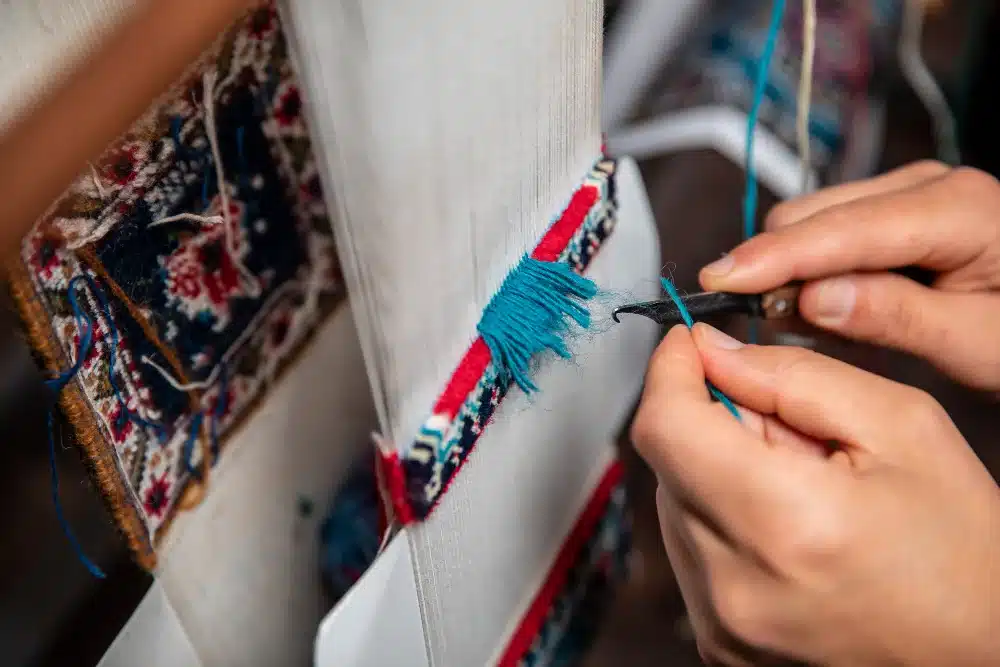
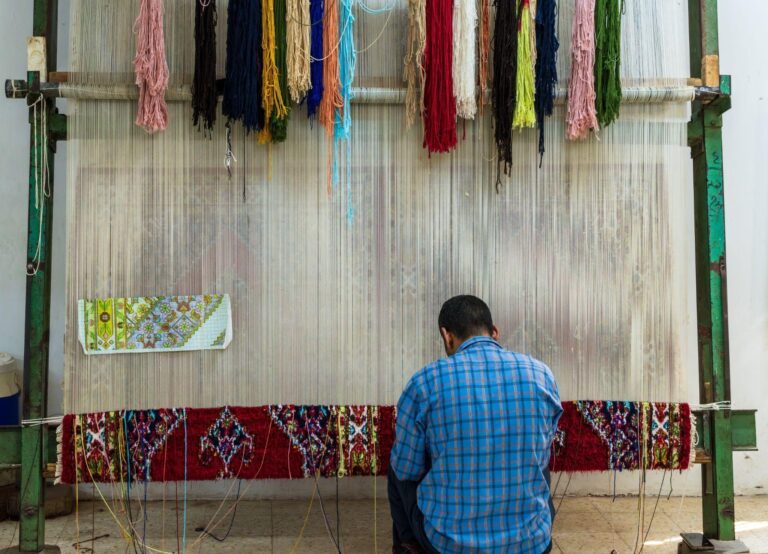
There are many different types of rug constructions, but the two main categories often used to describe rug construction are: Woven or Tufted. Woven rugs are made on a loom, and traditionally are made by hand across the globe in what is referred to often as the ‘rug belt’ stretching from Morocco to China. Woven rugs include kilims, dhurries, Navajo, hand knotted, braided, needlepoint and other types of flat weave rugs.
Tufted rugs, on the other hand, are made by having a stencil projected or drawn onto a scrim material and then filled in with fibers using a tufting gun, a specialized tool with a needle on it and a trigger. The needle is punched through the thin material and the trigger is pulled, creating a ‘tuft’ of fiber that is part of the face of the rug. Since these rugs are thinner and lack dimensional stability, a water-based glue is applied to the back and another piece of material is then applied.
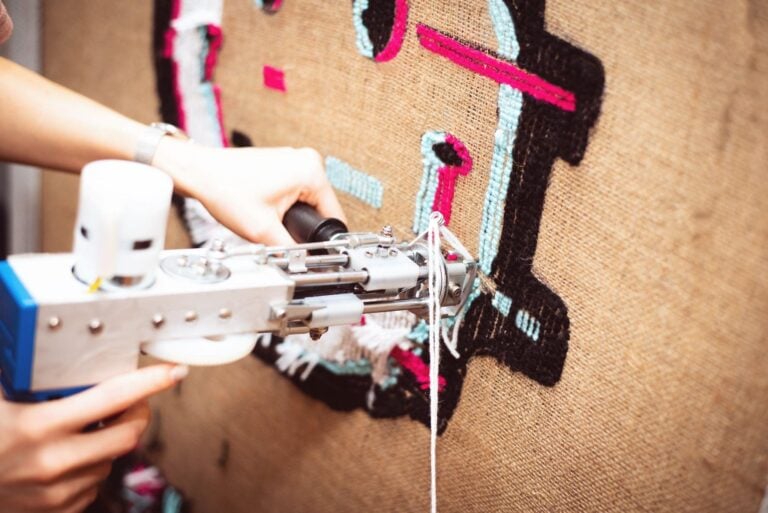
The easiest way to tell the difference between a woven or a tufted rug is to take a look at the back of the rug. If you can see the design on the back of the rug, most likely you have a type of a woven rug. If you see a piece of fabric on the back, likely you have a tufted rug. (Although sometimes a fabric is applied to some woven rugs to make them more stable towards the end of their usable life.)
Many professional rug cleaners can easily tell the difference between a woven or tufted rug from pictures that you could send. The office staff or technicians at Pinnacle Eco Clean routinely identify these types of constructions for their clients.
But how do you tell where a rug is actually from?
This part can get a little tricky. If you’re lucky, there may be a tag on the back of the rug, usually in a corner. This tag may tell you where the rug was made. We have even seen some rug tags telling us the exact town where the rug was made. All too often, rug tags do not tell the real story, and actually have been known to give false information. If your rug doesn’t have a tag on it, then some detective work needs to be done.
The first thing we look at is the face (or topside) of the rug. Sometimes it is glaringly obvious as to where the rug is from, as is the case for many rugs from China – think: Does it have a dragon or other Chinese symbols on it? Then it is most likely from this area of the world.
There are elements of design such as motifs and symbols that we can look at to tell where a rug is from, as is the case for many Turkmen or Persian rugs. For instance, rugs made in the Persian (Iranian) city of Heriz have a distinct design in the border as well as medallions that many people can quickly identify.
There are, however, reproductions. Rug making in India and some other countries often borrow designs from other areas of the world and make rugs using these. A lot of times, we see reproductions of Heriz rugs made in India that we refer to as ‘Indo-Heriz’ rugs.
To tell the difference, we look at four main components of these rugs. Color, knots, material and fringe.
1. Color
- Persian Heriz rugs often use a deep crimson red, which over time with exposure to sunlight, fades to more of a dusty rose tone.
- Indo-Heriz versions use a red that has more yellow in the dye, making it more of an orange-red.
2. Knots
- Persian Heriz rugs usually have a finer, tighter knot structure.
- Indo-Heriz rugs may have a thicker yarn, resulting in a bulkier knot structure.
3. Material
- Both rugs are commonly made with wool yarns on a cotton foundation.
- Persian rugs have a softer, shinier wool
- Indian variants use a wool that is coarser.
- This is a difference you learn from experience.
4. Fringe
- There are subtle differences in the way the fringes are tied off on both types of rugs that we can tell by looking at the cotton, what color it is and how coarse or fine it is and how they weave what we refer to as the ‘kilim strip’ This is the flat woven cotton foundation yarns between the tassels of the rug and the pile (nap) of the rug.
Why it matters
Why does this matter? What difference does it make as to where the rug was made?
Where a rug is made can affect:
- Value
- Durability
- How it should be cleaned
- What repairs are possible or worth doing
Different rugs from different areas of the world vary in value. For instance, a rug made out of silk in the Persian city of Qum typically sells for much more than silk rugs made in India. Genuine hand-knotted rugs from Türkiye sell for more than rugs from Afghanistan. Labor rates, material costs and quality, as well as age and condition of the rug all play a factor in the value of a rug. For instance, an antique rug from the Persian city of Bidjar in fair condition may sell for more than a brand new rug from India, while if there is a lot of damage to the rug from wear or moths, the rug may be unsellable.
A note on sentimental value
Unfortunately, sentimental value does not always translate into monetary value. This can be especially difficult to hear when a rug is tied to family history.
However, many people choose to preserve their heirloom rugs because keeping the textile alive and in use is the point, even if the market value of the piece doesn’t justify the cost of maintenance.
What to do?
If you have a rug that you have always wondered about, or if you are looking to buy a rug, we would be happy to set up an appointment to help you to be a more informed consumer. In this way, you can have more confidence in what you are buying, as well as knowing the limitations of the rug. Knowing the limitations of rugs is paramount in your purchasing journey. This can save you a lot of heartache in the future, as well as knowing how to expect a rug to perform in your specific living situation.
Pinnacle Eco Clean has been in business for over 45 years, and we take great pride in maintaining home textiles in the Rochester, New York area.
Learn more by visiting pages on our website, as well as taking a look at the videos that we have made regarding rug washing.
Tip for a quick ID: If you want to send photos, include:
- The full front of the rug
- A back corner of the rug
- A close-up of the fringe
- A few close-ups of the pile and design, especially a corner of the rug
Call Pinnacle Eco Clean or book your appointment online today.